
Tax Reform
Nigeria Tax Relief 2026: How to Claim Rent Relief, Pension and Other Tax Deductions


Nigeria’s new tax relief system, which took effect on January 1, 2026, introduced important changes to how personal income tax is calculated. One area Nigerians should pay close attention to is tax relief.
So in this article, you will learn how to claim Nigeria tax relief 2026, including rent relief, pension, NHF, NHIS, life insurance and eligible housing loan interest.
Under the Nigeria Tax Act 2025, individuals can claim certain eligible deductions before their chargeable income is calculated. These deductions may reduce the amount of income subject to tax, potentially lowering the personal income tax they owe.
One of the most talked-about provisions is the new rent relief, which allows eligible taxpayers to deduct 20 per cent of their annual rent, subject to a maximum of ₦500,000. Other allowable deductions include qualifying pension contributions, National Housing Fund contributions, National Health Insurance Scheme contributions, eligible life insurance premiums and interest paid on certain owner-occupied housing loans.
However, these benefits are not simply automatic discounts. Taxpayers must meet the relevant conditions, declare their claims correctly and provide supporting documents when required by the appropriate tax authority.
This guide explains the tax reliefs available in Nigeria in 2026, who qualifies, how to calculate them and what individuals should do to claim them.
What Is Tax Relief Under Nigeria’s 2026 Tax System?
Tax relief refers to an amount that the law allows a taxpayer to deduct from eligible income before calculating the tax payable.
In practical terms, it means that your entire income may not necessarily be subject to personal income tax. Certain qualifying contributions and expenses can be deducted first, leaving a lower amount known as chargeable income.
For example, imagine an employee earns ₦6 million annually and qualifies for certain deductions. If those deductions total ₦800,000, the employee’s chargeable income may be reduced to ₦5.2 million, subject to the applicable tax rules.
The tax authority then applies the relevant personal income tax bands to the chargeable income rather than simply taxing the original gross amount.
This distinction is important because the amount of tax you pay depends not only on how much you earn but also on the deductions you are legally entitled to claim.
1. Rent Relief: How Nigerians Can Claim the New Housing Tax Deduction
Rent relief is one of the major personal income tax provisions introduced by the Nigeria Tax Act 2025.
Under Section 30 of the Act, an individual can claim a deduction equal to 20 per cent of the annual rent actually paid, subject to a maximum of ₦500,000.
This means the amount you can claim depends on how much rent you paid during the relevant year.
How Much Rent Relief Can You Claim?
The calculation is straightforward:
Rent relief = 20% of qualifying annual rent paid, up to ₦500,000.
Here are some examples:
| Annual Rent Paid | 20% of Rent | Allowable Rent Relief |
|---|---|---|
| ₦500,000 | ₦100,000 | ₦100,000 |
| ₦1,000,000 | ₦200,000 | ₦200,000 |
| ₦1,500,000 | ₦300,000 | ₦300,000 |
| ₦2,000,000 | ₦400,000 | ₦400,000 |
| ₦2,500,000 | ₦500,000 | ₦500,000 |
| ₦3,000,000 | ₦600,000 | ₦500,000 |
| ₦4,000,000 | ₦800,000 | ₦500,000 |
For instance, if you pay ₦2 million in annual rent, you may claim ₦400,000 as rent relief.
If you pay ₦3 million, 20 per cent would be ₦600,000. However, the statutory limit means your allowable deduction remains ₦500,000.
The relief is therefore capped at ₦500,000, regardless of how high your rent is.
Who Qualifies for Rent Relief?
Individuals who actually pay rent and meet the relevant declaration and documentation requirements may qualify.
The provision is relevant to employees, self-employed individuals and other eligible taxpayers whose personal income is subject to the applicable rules.
However, owning a house and paying no rent does not create a rent relief claim. You cannot claim rent that you did not actually pay.
Information Required to Claim Rent Relief
The Joint Revenue Board’s 2026 Personal Income Tax Guidelines specify the minimum information required for a rent relief claim.
This includes:
- The legal name of the tenant.
- The actual amount of rent paid.
- The period covered by the rent payment.
- The landlord’s full name.
- The landlord’s mobile number, Tax ID or National Identification Number.
- The address of the rented property.
Taxpayers should retain relevant tenancy agreements, rent receipts, bank transfer evidence and other records that support the amount declared.
What Happens If You Pay Rent for Two Years in Advance?
This is an important issue for Nigerians who pay rent several months or years in advance.
The 2026 guidelines explain that rent relief is calculated on an actual-year basis. This means rent paid for a period covering more than one calendar year must be apportioned to the relevant year.
For example, suppose you pay ₦2 million in 2026 for a two-year tenancy covering January 2026 to December 2027.
The rent attributable to 2026 is ₦1 million. Your rent relief for that year would therefore be 20 per cent of ₦1 million, which is ₦200,000.
You cannot automatically claim 20 per cent of the entire two-year payment in the first year.
Can Tenants Sharing an Apartment Claim Rent Relief?
Yes. The 2026 Personal Income Tax Guidelines provide for shared tenancies.
Each qualifying tenant may claim rent relief based on the portion of rent that the individual actually incurred, subject to the maximum ₦500,000 limit.
For example, if two tenants share an annual rent of ₦2 million equally, each tenant’s share is ₦1 million.
Each may potentially claim 20 per cent of their respective share, amounting to ₦200,000, provided the required conditions and documentation are satisfied.
2. Pension Contributions: How They Reduce Your Taxable Income
Pension contributions are another eligible deduction under Nigeria’s 2026 personal income tax framework.
Employees who contribute to an approved pension arrangement under the Pension Reform Act may deduct qualifying contributions when calculating their chargeable income.
This provision recognises that money set aside for retirement should receive the applicable tax treatment rather than simply being treated as ordinary take-home income.
For employees under the Contributory Pension Scheme, the relevant employee contribution must actually be deducted and remitted to an approved Pension Fund Administrator.
The 2026 guidelines make clear that the deductible amount is limited to the actual qualifying contribution paid and remitted.
Do All Pension Contributions Qualify?
No. Taxpayers should not assume that every payment described as a pension contribution automatically qualifies.
The contribution must satisfy the applicable pension rules and documentation requirements.
Employees should check their payslips and pension statements to confirm that the relevant contributions have been properly recorded and remitted.
If you are self-employed or make additional voluntary pension contributions, confirm with your Pension Fund Administrator and relevant tax authority how your particular contribution should be treated.
3. National Housing Fund Contributions
Contributions made under the National Housing Fund are also recognised as eligible deductions under the Nigeria Tax Act 2025.
The National Housing Fund is designed to support housing development and access to affordable housing finance.
Where an individual makes qualifying contributions to the Fund, the actual amount contributed may be deducted when calculating chargeable income.
The 2026 guidelines specify that the deduction is limited to the amount actually contributed.
Employees should therefore retain relevant payslips and contribution records showing that the money was deducted and paid into the appropriate fund.
Do not claim an amount that was never contributed or that cannot be supported by the available records.
4. National Health Insurance Scheme Contributions
Qualifying contributions under the National Health Insurance Scheme are also deductible under the new personal income tax rules.
The deduction applies to the actual amount deducted and remitted under the relevant scheme.
This means taxpayers should be able to demonstrate that the contribution was genuinely made.
Where the contribution appears on an employee’s payslip, it is advisable to retain the payslip and any available evidence of remittance.
The tax authority may request supporting documents before allowing the deduction.
5. Life Insurance Premiums and Deferred Annuities
The Nigeria Tax Act 2025 also recognises certain payments made for life insurance and deferred annuity arrangements.
An individual may claim an eligible deduction for the annual amount paid during the preceding year of assessment in respect of:
- Life insurance covering the taxpayer.
- Life insurance covering the taxpayer’s spouse.
- A qualifying deferred annuity contract on the taxpayer’s life.
- A qualifying deferred annuity contract on the spouse’s life.
The deduction is based on the amount actually paid and must meet the requirements of the Act.
For example, if you paid ₦180,000 in qualifying life insurance premiums during the relevant period, that amount may be considered for deduction, provided the policy and payment satisfy the statutory conditions.
You should retain your insurance policy documents, premium receipts and payment records.
Not every insurance product qualifies. General insurance policies, such as motor or household insurance, should not automatically be treated as eligible life insurance deductions.
6. Interest on Loans for Owner-Occupied Residential Property
Another eligible deduction concerns interest paid on loans used to develop an owner-occupied residential house.
This provision may benefit individuals who have taken qualifying housing loans to purchase, construct or develop their principal residence.
However, there is an important distinction between the interest paid on a qualifying loan and the repayment of the loan principal.
Under the 2026 guidelines, only the interest component qualifies. The amount used to repay the original loan does not qualify.
The property must also be the taxpayer’s principal residence or intended to become the taxpayer’s residence while it is being developed. A property acquired for commercial purposes or rental investment does not meet this particular condition.
Taxpayers should retain their loan agreements, repayment schedules, bank statements and lender statements showing the interest actually paid.
7. How to Claim Tax Relief in Nigeria in 2026
Knowing the deductions available is only the first step. You must also declare them correctly and provide the necessary evidence.
Section 31 of the Nigeria Tax Act 2025 requires eligible deductions to be claimed in writing in the form prescribed by the relevant tax authority.
The Joint Revenue Board’s 2026 guidelines also require appropriate documentary evidence for the deductions.
Here is a practical approach.
Step 1: Identify the Tax Authority Responsible for You
For most individuals, personal income tax is administered by the Internal Revenue Service of the state or the Federal Capital Territory where they reside.
Certain categories, including specified non-residents, diplomats and members of the armed forces, fall under the administration of the Nigeria Revenue Service.
If you live in Lagos, for example, the Lagos State Internal Revenue Service is the relevant authority for most ordinary resident individual taxpayers.
Step 2: Gather Your Income Records
Prepare records showing your income for the relevant year.
Depending on your circumstances, these may include:
- Salary and allowance records.
- Payslips.
- Employer’s annual income statement.
- Business income records.
- Records of income from other sources.
- Evidence of tax already deducted or paid.
Individuals with more than one income source should ensure that the relevant income is properly disclosed.
Step 3: Gather Evidence of Your Eligible Deductions
Collect documents that support each deduction you intend to claim.
These may include:
- Rent receipts and tenancy agreements.
- Evidence of rent payments.
- Pension contribution statements.
- National Housing Fund contribution records.
- National Health Insurance Scheme contribution records.
- Life insurance premium receipts.
- Deferred annuity payment records.
- Mortgage or housing loan statements showing qualifying interest.
The records should relate to the relevant year of assessment.
Step 4: Calculate Your Eligible Deductions
Work out the actual amount you are entitled to claim under each category.
For rent relief, calculate 20 per cent of the qualifying annual rent paid, subject to the ₦500,000 maximum.
For pension, NHF and NHIS contributions, use the actual qualifying amounts contributed and remitted.
For life insurance and housing loan interest, use the amounts that meet the statutory conditions.
Avoid estimating figures or claiming deductions simply because they appear on another person’s tax assessment.
Step 5: Declare the Deductions to Your Tax Authority
Submit your claims through the relevant tax authority’s prescribed process.
Employees should provide the necessary information to their employers or payroll departments so that eligible deductions can be reflected in the appropriate PAYE computation.
Where an annual return or direct assessment is required, disclose the relevant deductions in the appropriate sections of the return.
Step 6: Keep Your Supporting Documents
Do not discard receipts, bank statements, pension records or other evidence after submitting your claim.
The tax authority may request additional documents to verify the information provided.
If you cannot support a deduction with satisfactory evidence, the authority may refuse the claim or allow only the part that can be substantiated.
8. Example: How Tax Relief Can Reduce Your Taxable Income
Consider an employee who earns an annual income of ₦6 million and pays ₦1.5 million in annual rent.
For illustration, assume the employee also has the following qualifying deductions:
| Description | Amount |
|---|---|
| Annual employment income | ₦6,000,000 |
| Rent relief: 20% of ₦1.5 million | ₦300,000 |
| Qualifying pension contribution | ₦480,000 |
| Other eligible deductions | ₦0 |
| Total deductions | ₦780,000 |
| Chargeable income | ₦5,220,000 |
The employee’s chargeable income is reduced from ₦6 million to ₦5.22 million.
Using the 2026 personal income tax bands:
| Tax Band | Rate | Tax Payable |
|---|---|---|
| First ₦800,000 | 0% | ₦0 |
| Next ₦2,200,000 | 15% | ₦330,000 |
| Remaining ₦2,220,000 | 18% | ₦399,600 |
| Total annual tax | ₦729,600 |
This is an illustrative calculation, not an individual tax assessment. It assumes the stated income and deductions are correctly classified and that no other income, benefits, credits or adjustments affect the calculation.
The example demonstrates why taxpayers should understand and declare the deductions they are legally entitled to claim.
9. Does Everyone Qualify for the Same Tax Relief?
No. Eligibility depends on the taxpayer’s actual circumstances and the conditions attached to each deduction.
For example:
- A person who does not pay rent cannot claim rent relief.
- Someone who has no qualifying pension contribution cannot claim a pension deduction.
- A taxpayer who has not contributed to the National Housing Fund cannot claim an NHF deduction.
- Someone paying off a housing loan cannot deduct the principal repayment as mortgage interest.
- A taxpayer who has no qualifying life insurance or deferred annuity payment cannot claim that deduction.
The law does not allow individuals to invent expenses or claim deductions simply to reduce their tax bills.
Every claim should be accurate and supported by the appropriate records.
10. What Happened to the Old Consolidated Relief Allowance?
One major change under the Nigeria Tax Act 2025 is the removal of the previous Consolidated Relief Allowance used under the former personal income tax framework.
The new system introduces rent relief alongside other eligible deductions.
Under the previous framework, the Consolidated Relief Allowance was calculated using a statutory formula involving a fixed amount and a percentage of gross income.
The new framework instead provides a rent-based deduction of 20 per cent of annual rent paid, subject to the ₦500,000 maximum.
This means taxpayers should not continue applying the old Consolidated Relief Allowance formula when calculating their personal income tax under the 2026 rules.
They should use the new provisions and the applicable tax guidelines.
11. Common Mistakes to Avoid When Claiming Tax Relief
Although tax relief can reduce chargeable income, mistakes in declaring deductions can create problems with the tax authority.
Here are some common errors taxpayers should avoid.
Claiming rent that was not paid: Rent relief is based on actual rent paid. You should not declare an amount that you cannot substantiate.
Ignoring the ₦500,000 rent relief limit: Even when 20 per cent of your annual rent exceeds ₦500,000, the maximum deduction remains ₦500,000.
Claiming the full amount of a housing loan repayment: Only qualifying interest on an eligible owner-occupied residential loan is deductible, not the principal repayment.
Using the wrong year’s expenses: Deductions must be reported in the appropriate year of assessment. Rent paid for a period covering multiple calendar years may need to be apportioned.
Failing to retain evidence: A claim may be rejected if the taxpayer cannot provide satisfactory supporting documents.
Using outdated tax calculations: The old Consolidated Relief Allowance and previous personal income tax calculations should not be substituted for the 2026 rules.
Declaring false information: Deliberately providing inaccurate information to obtain a tax advantage can expose a taxpayer to penalties and other consequences under the tax laws.
Frequently Asked Questions About Tax Relief in Nigeria
1. How much rent relief can I claim in Nigeria in 2026?
You can claim 20 per cent of the annual rent actually paid, subject to a maximum deduction of ₦500,000. The claim must meet the relevant declaration and documentation requirements.
2. Can I claim rent relief if I live in my own house?
No. Rent relief is based on rent actually paid. If you own and occupy your home without paying rent, you cannot claim this particular deduction.
3. Can self-employed Nigerians claim rent relief?
Eligible self-employed individuals may claim rent relief if they actually pay rent and satisfy the applicable requirements. They should declare the claim in their tax return and retain supporting evidence.
4. Is pension contribution tax-deductible in Nigeria?
Qualifying pension contributions made under the Pension Reform Act are eligible deductions. The amount must satisfy the applicable requirements and be supported by appropriate records.
5. Can I claim NHF and NHIS contributions as tax deductions?
Yes. Qualifying National Housing Fund and National Health Insurance Scheme contributions are recognised deductions. The allowable amount is limited to the actual qualifying contribution made and remitted.
6. Can I claim life insurance premiums as tax relief?
Qualifying premiums paid for life insurance covering you or your spouse, as well as certain deferred annuity payments, may be deducted subject to the conditions in the Nigeria Tax Act 2025.
7. Can I claim the full amount I pay towards my mortgage?
No. The qualifying deduction applies to the interest component of a loan used to develop your owner-occupied residential property. The principal repayment does not qualify.
8. Do tax reliefs apply automatically to my salary?
You should not assume that every eligible deduction will automatically appear in your PAYE calculation. Provide the required information and evidence to your employer or relevant tax authority and check that approved deductions have been properly reflected.
9. Can I claim more than ₦500,000 in rent relief?
No. The maximum rent relief under the provision is ₦500,000, even if 20 per cent of your annual rent is higher.
10. What documents do I need to claim rent relief?
The 2026 guidelines require the tenant’s legal name, actual rent paid and period covered, the landlord’s full name and one of their mobile number, Tax ID or NIN, and the rented property’s address. Keep receipts, tenancy agreements and payment evidence as supporting records.
Conclusion: Understand Your Tax Relief Rights Before Paying More Tax
The Nigeria Tax Act 2025 gives individuals access to several eligible deductions that can reduce their chargeable income under the new personal income tax system.
Rent relief is particularly important because eligible taxpayers can deduct 20 per cent of annual rent paid, up to ₦500,000. Qualifying pension, NHF and NHIS contributions, life insurance premiums and interest on eligible owner-occupied housing loans may also reduce taxable income.
However, these deductions are subject to specific conditions. Taxpayers should maintain accurate records, declare their claims correctly and ensure that every amount submitted can be supported with evidence.
Understanding these provisions can help employees, business owners and other individual taxpayers make informed financial decisions and avoid paying more personal income tax than the law requires.
For the most accurate information, consult the relevant State Internal Revenue Service, the FCT Internal Revenue Service or the Nigeria Revenue Service, depending on which authority administers your tax affairs.




Every taxable individual and business operating in Nigeria needs to understand the country’s new Tax Identification system, particularly following the commencement of the Nigeria Tax Administration Act 2025 on January 1, 2026.
Learn how to retrieve, register and verify your Nigeria Tax ID in 2026 using your NIN or CAC number. See the official portal and requirements.
The introduction of the harmonised Tax Identification Number, commonly called Tax ID, is part of the Federal Government’s efforts to improve tax administration, strengthen taxpayer identification and create a more coordinated tax system across the country.
Under the new framework, individuals and businesses are expected to have a valid Tax ID for relevant tax compliance activities and transactions.
However, many Nigerians are still asking important questions: How do I get my Tax ID? Can I retrieve it using my NIN? Do businesses need a separate Tax ID? What happens if I already have a TIN? And how can I verify whether my Tax ID is valid?
The good news is that the government has introduced an online platform that allows individuals and registered organisations to retrieve their Tax ID using existing identity records.
This guide explains everything you need to know about Nigeria’s Tax ID system in 2026, including how to retrieve your number, how businesses can obtain theirs, how to check your Tax ID and what to do if your details are incorrect.
What Is a Tax Identification Number (Tax ID) in Nigeria?
A Tax Identification Number is a unique identification number assigned to an individual or organisation for tax administration purposes.
It helps the relevant tax authorities identify taxpayers, maintain accurate records, administer tax obligations and monitor compliance.
The new Nigerian Tax ID system is jointly administered through the Nigeria Revenue Service (NRS) and the Joint Revenue Board (JRB).
Rather than requiring every individual to create an entirely separate identity for tax purposes, the harmonised system links taxpayer records to existing government identification databases.
For individuals, the Tax ID is linked to the National Identification Number (NIN) issued by the National Identity Management Commission.
For registered businesses and organisations, it is linked to Corporate Affairs Commission registration records.
This approach is intended to reduce duplicate taxpayer records and make it easier to identify individuals and businesses across Nigeria’s tax administration system.
The official Tax ID portal describes the number as a unique identifier for tax administration, compliance and enforcement.
Who Needs a Tax ID in Nigeria in 2026?
Section 4 of the Nigeria Tax Administration Act 2025 requires every taxable person to register with the relevant tax authority and obtain a Tax ID for tax compliance purposes.
The requirement covers individuals and organisations that fall within the law’s definition of taxable persons.
The main categories include:
1. Employees and Salaried Workers
Individuals working in private companies, government institutions, banks, schools, hospitals and other organisations may need a Tax ID for employment-related tax documentation and compliance.
Having a Tax ID helps the relevant tax authority identify the employee’s tax records.
2. Self-Employed Individuals
Freelancers, consultants, traders, artisans, professionals and other self-employed individuals who earn taxable income are also covered.
This includes people who operate independently without working for a traditional employer.
3. Business Owners
Individuals operating businesses and earning taxable income must comply with the applicable registration requirements.
Registered businesses also need their own appropriate taxpayer identification.
4. Companies and Registered Organisations
Companies incorporated with the Corporate Affairs Commission must have a Tax ID for relevant tax administration and compliance activities.
Other registered organisations may also fall within the applicable registration requirements.
5. Non-Resident Taxpayers
Non-resident individuals and organisations with relevant taxable activities or income in Nigeria may also be required to obtain a Tax ID under the applicable provisions.
The specific registration requirements depend on the nature of their Nigerian income and activities.
Is Tax ID Mandatory in Nigeria From January 1, 2026?
The Nigeria Tax Administration Act 2025 commenced on January 1, 2026.
Under Section 4, every taxable person must register with the relevant tax authority and obtain a Tax ID for tax compliance purposes.
Section 8 also provides for the use of Tax ID in tax returns, official tax correspondence, relevant transaction documents and contracts with government entities.
It further requires persons engaged in banking, insurance, stockbroking and other financial services to ensure that taxable persons provide a Tax ID.
The official Tax ID portal also identifies banking, employment documentation, government contracts and statutory filings among the services for which a valid Tax ID may be required.
However, this should not be misunderstood to mean that every Nigerian’s existing bank account will automatically be blocked simply because the person has not retrieved a Tax ID. The Joint Revenue Board previously clarified that the provision was not intended to cause automatic closure of bank accounts.
The important requirement is for taxable persons to have the appropriate tax identification when required for relevant services and transactions.
How to Retrieve Your Tax ID in Nigeria Using Your NIN
If you are an individual, you can retrieve your Tax ID through the official Nigerian Tax ID portal.
The process is designed to use your existing NIN rather than requiring you to create an entirely new taxpayer identity.
Follow these steps:
Step 1: Visit the Official Tax ID Portal
Open the official Nigeria Tax ID retrieval website:
You can also access the Joint Revenue Board version:
Make sure you are using one of these official government portals rather than an unofficial website.
Step 2: Select Individual Taxpayer
On the homepage, select the Individual option.
This section is designed for people retrieving their personal Tax ID using their National Identification Number.
Step 3: Enter Your NIN
Select the National Identification Number option and enter your 11-digit NIN.
Ensure that the number is correct before proceeding.
Step 4: Confirm Your Personal Details
The portal may request additional information to verify your identity.
This includes:
- First name.
- Last name.
- Date of birth.
Your details should match the information registered with the National Identity Management Commission.
Even a small difference in your name or date of birth may cause the verification process to fail.
Step 5: Complete the Verification Process
Follow the instructions displayed on the portal and provide the required consent for identity verification.
The system checks your information against the relevant government identity records.
Step 6: Retrieve Your Tax ID
If your identity information matches the records and the verification is successful, the portal should display your Tax ID and associated registration information.
Save the number securely for future tax-related activities.
The portal’s official guidance explains that retrieval confirms an existing harmonised tax identity rather than creating a second identity.
How to Retrieve Your Business Tax ID Using CAC Registration Details
Registered businesses and organisations have a separate identification process.
Instead of using an individual’s NIN, the business Tax ID is linked to its Corporate Affairs Commission registration details.
If you own a registered company or business, follow these general steps:
- Visit the official Nigerian Tax ID portal.
- Select the Corporate or Registered Organisations option.
- Choose the appropriate organisation category.
- Enter your CAC registration number.
- Provide any additional information requested.
- Complete the verification process.
- Retrieve the business Tax ID displayed by the system.
Ensure that the business name and registration details match the information held by the CAC.
If the details do not match, you may need to correct the underlying registration information or contact the relevant authority for assistance.
Important: A company and its director are separate taxpayers. A company should not use a director’s personal Tax ID as a substitute for its own business Tax ID.
What If You Already Have an Old TIN?
This is one of the most important issues for Nigerians who registered with a tax authority before 2026.
Many individuals and businesses already have Taxpayer Identification Numbers issued under the previous tax administration system.
The introduction of the harmonised Tax ID does not mean that everyone should apply for another number.
Section 7 of the Nigeria Tax Administration Act 2025 specifically provides that a taxable person who already has a valid Tax ID must not apply for or be issued another Tax ID.
The law also provides for the unification of multiple Tax IDs where a taxpayer discovers that more than one number has been issued to them.
Therefore, if you already have a valid TIN, you should first check your existing tax identity through the official portal or the relevant tax authority.
Do not pay an agent to create another number for you without first confirming whether your existing identification has already been integrated into the new system.
How to Verify Your Nigeria Tax ID
Retrieving your Tax ID is only one part of the process.
You should also ensure that the number is valid and correctly linked to your personal or business information.
The official Tax ID portal provides a retrieval and verification service.
To check your details:
- Visit the official Tax ID portal.
- Select the appropriate taxpayer category.
- Enter your NIN or CAC registration details.
- Provide the additional information requested.
- Complete the verification process.
- Review the taxpayer information displayed.
The portal can confirm whether your identity records match the national tax identification system.
For certain tax administration purposes, the Nigeria Revenue Service also provides a separate Tax ID validation service.
This allows users with the appropriate validation details to check taxpayer registration information.
You can access it here:
https://www.nrs.gov.ng/taxpayer-services/taxpayer-validation
Always use official government platforms when verifying sensitive tax information.
What Should You Do If Your Tax ID Cannot Be Retrieved?
Sometimes, the online retrieval process may not work as expected.
This does not necessarily mean that you do not have a Tax ID.
The problem may be caused by incorrect personal information, an identity mismatch, incomplete records or a temporary technical issue.
If you encounter a problem, consider the following steps.
1. Check Your NIN
Ensure that you entered the correct 11-digit NIN.
A typing error can prevent the system from identifying your records.
2. Confirm Your Personal Information
Your first name, last name and date of birth should match the information registered with NIMC.
If your NIN records contain an error, you may need to correct them through the appropriate NIMC procedure.
3. Check Your CAC Information
For businesses, confirm that the CAC registration number and organisation details are correct.
If the business has undergone a name change or other registration update, ensure that the information is properly reflected in the relevant records.
4. Contact the Relevant Tax Authority
If your information is correct but the portal still cannot retrieve your Tax ID, contact the Nigeria Revenue Service or Joint Revenue Board for assistance.
Individuals may also contact their relevant State Internal Revenue Service or the FCT Internal Revenue Service where appropriate.
5. Avoid Applying for Multiple Tax IDs
Do not create another tax identity simply because you cannot retrieve the existing one.
The law prohibits a taxable person who already has a valid Tax ID from obtaining another one.
The appropriate step is to resolve the identity or record issue.
How to Update Your Tax ID Information
Your Tax ID is linked to personal or business information that should remain accurate.
If your contact details, address, business particulars or other relevant information change, you should notify the appropriate tax authority.
Section 9 of the Nigeria Tax Administration Act 2025 requires taxable persons to notify the relevant tax authority of changes in their particulars within 30 days of the change.
Relevant changes may include:
- Change of personal name.
- Change of residential address.
- Change of business address.
- Change of telephone number.
- Change of email address.
- Changes to relevant business ownership or registration particulars.
The official Tax ID portal also provides a service for updating certain taxpayer particulars.
Keeping your records current can help prevent problems when filing tax returns, accessing services or verifying your identity.
Is It Free to Get a Tax ID in Nigeria?
The official Tax ID retrieval portal provides a government service for retrieving your existing Tax ID.
You should use the official platform rather than paying an unofficial agent to retrieve the number on your behalf.
Be cautious of individuals or websites claiming that they can sell you a Tax ID or guarantee a special number.
Your Tax ID is a government-issued taxpayer identity, not a product that should be purchased from an intermediary.
Where a separate registration or administrative service has a legally prescribed fee, confirm the charge directly with the relevant tax authority and request an official payment reference and receipt.
Never send money to a personal bank account simply because someone claims to be a tax registration agent.
What Is the Difference Between NIN, TIN and the New Tax ID?
These identification numbers serve different purposes, although they are connected under Nigeria’s new tax administration framework.
| Identification | Meaning | Main Purpose |
|---|---|---|
| NIN | National Identification Number | Identifies individuals within Nigeria’s national identity system. |
| TIN | Taxpayer Identification Number | Previously used to identify taxpayers for tax administration. |
| Tax ID | Harmonised Tax Identification | Identifies individuals and organisations within the current national tax administration system. |
The NIN is issued by the National Identity Management Commission.
The Tax ID is administered through the Nigeria Revenue Service and Joint Revenue Board and is linked to recognised identity records.
For individuals, the NIN is used as the foundation for retrieving the harmonised Tax ID.
For registered organisations, CAC registration details provide the corresponding identity link.
What Happens If You Do Not Have a Tax ID?
A taxable person who fails to comply with the registration requirements may face consequences under the Nigeria Tax Administration Act 2025.
Section 100 of the Act provides penalties for failure to register.
The statutory penalty includes:
- ₦50,000 for the first month of default.
- ₦25,000 for each subsequent month during which the failure continues.
The relevant tax authority may also take other steps permitted by law to enforce registration and tax compliance.
However, individuals should first establish whether they already have an existing Tax ID that can be retrieved through the official portal.
This is particularly important for people who previously registered with a State Internal Revenue Service or another tax authority.
Frequently Asked Questions About Nigeria Tax ID 2026
1. How can I get my Tax ID in Nigeria in 2026?
Visit the official Tax ID portal at taxid.nrs.gov.ng, select Individual, enter your 11-digit NIN and provide the additional personal information requested to retrieve your Tax ID.
2. Can I retrieve my Tax ID using my NIN?
Yes. Individuals can retrieve their harmonised Tax ID using their National Identification Number through the official government portal.
3. How do businesses get their Tax ID?
Registered businesses can retrieve their Tax ID using their Corporate Affairs Commission registration details through the corporate section of the official portal.
4. Is Tax ID the same as NIN?
No. NIN identifies individuals within Nigeria’s national identity system, while Tax ID identifies individuals and organisations for tax administration. The individual Tax ID is linked to the NIN.
5. Is my old TIN still valid in 2026?
An existing valid TIN should not automatically be treated as invalid simply because the new system has commenced. Check your details through the official Tax ID portal or the relevant tax authority before applying for another number.
6. Can I have two Tax IDs in Nigeria?
No. Section 7 of the Nigeria Tax Administration Act 2025 prohibits a taxable person who already has a valid Tax ID from applying for or being issued another one. Multiple records should be referred to the relevant authority for unification.
7. Do small business owners need a Tax ID?
Taxable business owners and registered organisations must comply with the applicable taxpayer registration requirements. Small-business tax exemptions do not automatically remove the requirement to obtain a Tax ID.
8. Is Tax ID compulsory for bank transactions?
The Nigeria Tax Administration Act requires persons providing banking, insurance, stockbroking and other financial services to ensure that taxable persons provide a Tax ID. The requirement should not be confused with an automatic closure of existing bank accounts.
9. What should I do if my Tax ID details are incorrect?
Check your NIN or CAC information and contact the relevant tax authority to correct inconsistencies. Do not apply for a second Tax ID simply because the existing record contains an error.
10. Where can I verify my Nigeria Tax ID?
You can use the official Nigerian Tax ID portal at taxid.nrs.gov.ng. The Nigeria Revenue Service also provides a Tax ID validation service for checking taxpayer registration information.
Conclusion: Why Every Taxpayer Should Understand Nigeria’s New Tax ID System
Nigeria’s harmonised Tax ID system is an important part of the country’s new tax administration framework.
By linking individual taxpayer records to NIN and business records to CAC registration information, the system is intended to improve identification, reduce duplicate records and make tax administration more coordinated.
For individuals, the retrieval process is relatively straightforward: use your NIN, confirm your personal information and follow the instructions on the official portal.
Business owners can retrieve their organisation’s Tax ID using their CAC registration details.
However, people who already have an existing TIN should verify their records before attempting to obtain another number. The law does not permit a taxpayer to hold multiple valid Tax IDs.
As Nigeria continues implementing its new tax framework, understanding your taxpayer identification requirements can help you avoid unnecessary complications when dealing with employers, banks, government agencies and tax authorities.
For more practical guides on Nigeria’s tax reforms, personal finance, business regulations and economic developments, continue following SteadyGist.com.
Disclaimer: This article is for general educational and informational purposes and does not constitute professional tax or legal advice. Tax registration requirements and administrative procedures may depend on individual circumstances. Always confirm your details through official government platforms or the relevant tax authority.

Filing personal income tax returns is an important responsibility for individuals earning taxable income in Nigeria. Whether you work for a private company, government institution, operate your own business, work as a freelancer or earn money from multiple sources, understanding how to file your annual tax returns can help you comply with Nigerian tax laws.
Learn how to file personal income tax returns in Nigeria in 2026, including required documents, filing steps, deadlines, PAYE and penalties.
Following the commencement of the Nigeria Tax Act 2025 and the Nigeria Tax Administration Act 2025 on January 1, 2026, Nigeria introduced changes to its tax administration framework. These changes affect how individuals declare their income, claim eligible deductions, calculate their tax obligations and submit annual returns.
One important requirement is that individuals must file annual income tax returns with the relevant tax authority, even where their employers already deduct Pay-As-You-Earn (PAYE) tax from their salaries.
This means that having PAYE deducted every month does not automatically remove your responsibility to file an individual annual tax return.
But how do you file personal income tax returns in Nigeria? What documents do you need? Where should you submit your returns? And what happens if you miss the filing deadline?
This guide explains the process step by step, including the requirements under the new tax laws and what individuals should know ahead of the next filing cycle.
What Is Personal Income Tax Return Filing?
Personal income tax return filing is the process through which an individual declares their income, eligible deductions, tax payments and other relevant financial information to the appropriate tax authority.
It allows the tax authority to determine whether the individual has paid the correct amount of tax based on their income and applicable tax provisions.
For example, an employee working for a company may have PAYE deducted from their monthly salary. However, the individual may also earn additional income from rental properties, consultancy, freelance work, business activities or other sources.
An annual tax return provides an opportunity to disclose these income sources and account for applicable deductions and taxes already paid.
The process is also relevant to self-employed individuals, traders, professionals, business owners and people earning income outside traditional employment.
Under Nigeria’s new tax framework, individuals are expected to provide accurate information about their income rather than relying solely on deductions made by employers.
Is Filing Personal Income Tax Returns Mandatory in Nigeria?
Yes. Filing annual personal income tax returns is a legal requirement for taxable individuals under the Nigeria Tax Administration Act 2025.
Section 13 of the Act requires every taxable person to submit an annual income tax return to the relevant tax authority without waiting for a formal notice or demand.
The requirement applies to individuals earning taxable income from employment, business, professional activities and other chargeable sources.
It is important to understand that filing a tax return and paying tax are two related but different responsibilities.
An individual may have already paid tax through PAYE or withholding tax deductions and still be required to submit an annual return declaring their income and tax payments.
Similarly, an individual whose tax liability is nil may still have a filing obligation if they fall within the category of persons required to submit returns.
The purpose is to ensure that the tax authority has an accurate record of the individual’s income and tax position.
Who Is Required to File Personal Income Tax Returns in Nigeria?
The annual filing requirement covers different categories of taxpayers.
1. Employees in Private Companies
Employees working for banks, telecommunications companies, manufacturing firms, construction companies, media organisations and other private businesses are generally required to declare their annual income.
Even when PAYE is deducted from their salaries, they should ensure that their individual filing obligations are fulfilled.
2. Government Workers and Public Servants
Civil servants and other public-sector employees may also have personal income tax filing obligations.
Their employers or government payroll departments may deduct PAYE, but the individual annual return requirement still applies.
3. Self-Employed Individuals
People who earn income independently, without working under a traditional employment arrangement, are also covered.
Examples include consultants, lawyers, accountants, designers, web developers, mechanics, traders and other professionals.
4. Business Owners and Entrepreneurs
Individuals operating businesses as sole proprietors or under other non-incorporated arrangements may have personal income tax obligations on their taxable business income.
Their returns should accurately reflect their income and relevant deductions.
5. Freelancers and Digital Content Creators
Freelancers, influencers, social media managers, YouTubers, online consultants and other digital professionals may also have tax obligations.
Income earned through client projects, advertising, sponsorships, consultancy and other commercial activities may be relevant when determining their taxable income.
6. Individuals With Multiple Income Sources
Someone who receives a salary and also earns rental income, consultancy fees, business profits or other taxable income should consider all relevant sources when preparing their annual return.
Filing only the employment income while leaving out other taxable income may result in an incomplete declaration.
When Is the Deadline for Filing Personal Income Tax Returns in Nigeria?
Under the Joint Revenue Board’s Personal Income Tax Guidelines 2026, individuals are required to submit annual income tax returns not later than March 31 of the relevant year of assessment.
The return covers income earned during the preceding basis period.
This distinction is important.
For example:
| Year of Assessment | Income Generally Covered | Statutory Filing Deadline |
|---|---|---|
| 2026 | January–December 2025 | March 31, 2026 |
| 2027 | January–December 2026 | March 31, 2027 |
Therefore, individuals preparing their next annual tax returns should begin organising their 2026 income records ahead of the March 31, 2027 statutory deadline.
Did Any State Extend the 2026 Filing Deadline?
Yes. Some tax authorities granted extensions during the 2026 filing season.
For example, the Lagos State Internal Revenue Service initially reminded taxpayers of the March 31 deadline. It subsequently extended the deadline to April 14 and later announced a further extension to April 21, 2026.
The Federal Capital Territory Internal Revenue Service also announced an extension to April 30, 2026.
These were specific extensions for the 2026 filing season. They should not be treated as permanent changes to the statutory March 31 deadline.
Taxpayers should always confirm announcements from their own relevant tax authority before relying on an extension.
Where Do You File Personal Income Tax Returns in Nigeria?
The appropriate tax authority generally depends on the individual’s residence and applicable tax jurisdiction.
For most individuals, personal income tax is administered by the relevant State Internal Revenue Service or the Federal Capital Territory Internal Revenue Service.
For example:
- Residents of Lagos State generally deal with the Lagos State Internal Revenue Service (LIRS).
- Residents of Abuja deal with the Federal Capital Territory Internal Revenue Service (FCT-IRS).
- Residents of other states deal with their respective State Internal Revenue Services.
Certain categories of taxpayers, including specified non-residents and other persons identified under the applicable guidelines, may fall under the administration of the Nigeria Revenue Service.
It is important to identify the correct tax authority before submitting your return.
Filing with the wrong authority can create unnecessary complications when verifying your tax records or obtaining tax-related documents.
Documents Required to File Personal Income Tax Returns in Nigeria
Before beginning your filing, gather the relevant documents and financial records.
The exact requirements may vary depending on the tax authority and the nature of your income.
However, the following documents are commonly required.
1. Tax Identification Details
You will need your applicable Tax ID or taxpayer identification details to access the relevant tax platform and identify your tax records.
Ensure that the information matches your personal details and the records held by the tax authority.
2. Employment Income Records
If you work for an organisation, obtain documents showing your earnings during the relevant year.
These may include:
- Annual salary statement.
- Payslips.
- Employment income summary.
- Bonus and allowance records.
- Evidence of PAYE deductions.
These documents help establish how much you earned and how much tax your employer deducted.
3. Pension Contribution Records
If you are claiming qualifying pension deductions, obtain evidence of your contributions.
This may include pension statements or other records from your Pension Fund Administrator.
4. National Housing Fund Contribution Evidence
Individuals claiming eligible National Housing Fund deductions should provide evidence of the actual contributions made.
5. National Health Insurance Contribution Records
Where applicable, evidence of qualifying health insurance contributions should be available.
6. Life Insurance Premium Receipts
If you intend to claim eligible life insurance deductions, obtain receipts or statements showing the qualifying premiums paid during the relevant period.
7. Rent Payment Evidence
Individuals claiming rent relief should prepare evidence of the rent actually paid.
The applicable requirements may include tenancy information, landlord details, payment evidence and other supporting documents.
8. Business Financial Records
Self-employed individuals and business owners should prepare accurate records of their business income and relevant expenses.
Depending on the nature of the activity, this may include:
- Income records.
- Sales and transaction records.
- Bank statements.
- Business expense records.
- Financial statements.
- A statement of accounts.
The Joint Revenue Board’s guidelines specify that individuals earning income from trade, business, profession or vocation should submit audited financial statements or a statement of accounts attested to by the taxpayer.
9. Evidence of Taxes Already Paid
If tax has already been deducted or paid during the year, gather the relevant evidence.
This may include:
- PAYE deduction records.
- Withholding tax credit notes.
- Direct assessment payment receipts.
- Other relevant tax payment evidence.
These records help prevent the same income from being incorrectly treated as though no tax has been paid.
How to File Personal Income Tax Returns in Nigeria: Step-by-Step Guide
The exact process may differ between tax authorities, but the following steps explain the general procedure.
Step 1: Identify Your Relevant Tax Authority
First, determine the tax authority responsible for administering your personal income tax.
For most individuals, this will be the State Internal Revenue Service where they are resident or the FCT-IRS for residents of the Federal Capital Territory.
If you are unsure, contact the relevant tax authority for clarification.
Step 2: Register or Access Your Taxpayer Account
Visit the official online tax platform provided by your relevant tax authority.
If you are filing for the first time, you may need to complete taxpayer registration and obtain or confirm your Tax ID.
If you already have an account, log in using your existing credentials.
Ensure that your personal information, contact details and taxpayer identification information are correct.
Step 3: Obtain the Individual Tax Return Form
Locate the individual annual income tax return section on the platform.
The Joint Revenue Board’s 2026 Personal Income Tax Guidelines provide an Individual Self-Assessment Return Form in Appendix 2, which may be used across tax jurisdictions unless the relevant authority prescribes otherwise.
The platform may provide an electronic version of the form.
Step 4: Declare Your Income From All Sources
Enter the relevant income earned during the preceding year.
This may include:
- Employment income.
- Business profits.
- Professional income.
- Rental income.
- Consultancy earnings.
- Other taxable income.
Do not report only your basic salary if you received other taxable income during the year.
The objective is to provide a complete and accurate picture of your income.
Step 5: Enter Your Eligible Deductions
Declare deductions you are legally entitled to claim.
Depending on your circumstances, these may include:
- Qualifying pension contributions.
- National Housing Fund contributions.
- National Health Insurance contributions.
- Eligible life insurance premiums.
- Interest on qualifying owner-occupied residential property loans.
- Rent relief.
Ensure that the amounts entered are supported by the relevant documents.
Step 6: Declare Taxes Already Paid
Enter the relevant tax deductions or payments made during the year.
For employees, this includes PAYE already deducted by their employers.
If you received income from other sources on which withholding tax was deducted, include the relevant evidence and details as required by the platform.
This allows the tax authority to consider tax already paid when reviewing your overall tax position.
Step 7: Upload Supporting Documents
Upload the documents requested by the relevant tax authority.
These may include salary statements, pension records, rent payment evidence, business financial statements and tax payment receipts.
Check that the documents are readable and that the information agrees with the figures entered in your return.
Step 8: Review Your Tax Computation
Before submitting your return, carefully review the information provided.
Check that:
- Your income figures are accurate.
- All relevant income sources have been disclosed.
- Your deductions are legitimate.
- Your tax payments have been correctly recorded.
- Your personal and taxpayer identification details are correct.
If the platform calculates your tax automatically, review the computation before proceeding.
Step 9: Submit Your Annual Tax Return
Once you are satisfied that the information is accurate, submit your return electronically or through the filing procedure prescribed by your tax authority.
Some authorities may require additional verification or supporting information.
Follow the instructions provided on the platform.
Step 10: Pay Any Outstanding Tax and Keep Your Confirmation
If the computation shows that you have outstanding tax, make payment through the approved channels and within the applicable deadline.
After submission, save your filing confirmation, payment receipts and any acknowledgement issued by the tax authority.
These records may be useful if you need to verify your filing status or respond to a future tax enquiry.
How to File Personal Income Tax Returns in Lagos State
Individuals resident in Lagos State generally file their personal income tax returns through the Lagos State Internal Revenue Service.
LIRS provides an electronic tax platform that allows taxpayers to register, submit returns, upload supporting documents and make payments.
The general procedure is:
- Visit the official LIRS e-Tax platform.
- Log in to your taxpayer account or complete the required registration.
- Locate the individual annual income tax return section.
- Complete the applicable Tax Form A.
- Declare your income and eligible deductions.
- Upload the requested supporting documents.
- Review your tax computation.
- Submit your return and pay any outstanding tax.
- Save your submission confirmation and payment evidence.
LIRS states that individuals can file through its electronic platform and that supporting documents must be uploaded for review.
Official Lagos State tax filing platform: LIRS e-Tax
For additional guidance, visit the Lagos State Internal Revenue Service website.
How to File Personal Income Tax Returns in Abuja
Residents of the Federal Capital Territory generally deal with the Federal Capital Territory Internal Revenue Service.
The FCT-IRS provides an online tax platform for individual taxpayers.
The process generally involves registering or logging into the platform, completing the relevant annual return, declaring income and deductions, uploading supporting documents and submitting the return.
Taxpayers should ensure that their personal information, including their Tax ID and other required details, is accurate.
Official FCT-IRS website: Federal Capital Territory Internal Revenue Service
How Do Employees File Tax Returns When PAYE Is Already Deducted?
This is one of the most important questions for Nigerian workers.
Many employees assume that once their employers deduct PAYE every month, they no longer have any responsibility to file personal income tax returns.
However, the 2026 tax framework requires taxable individuals to submit annual income tax returns.
If you are employed by an organisation, your employer’s PAYE deductions should form part of the tax information declared in your annual return.
You should obtain your annual salary statement and evidence of PAYE deductions from your employer.
When completing your return:
- Declare your employment income.
- Enter eligible deductions.
- Declare PAYE already deducted.
- Upload supporting documents.
- Review your tax position.
- Submit your annual return.
If your employer has deducted the correct amount of tax and you have no additional tax liability, the filing process may simply confirm your income and tax position.
However, where you have other taxable income or an underpayment, additional tax may be payable.
How Do Self-Employed Nigerians File Their Tax Returns?
Self-employed individuals generally need to provide a more detailed account of their earnings and business activities.
Unlike employees whose salaries are usually documented through payroll systems, independent professionals and business owners may receive payments from different customers, clients and commercial activities.
For this reason, keeping accurate financial records is important.
A self-employed individual should:
- Calculate total income earned during the year.
- Identify the relevant taxable business or professional income.
- Prepare accurate financial statements or a statement of accounts.
- Identify eligible deductions and exemptions.
- Declare relevant tax payments already made.
- Complete the individual self-assessment return.
- Upload the required supporting documents.
- Pay any outstanding tax.
The Joint Revenue Board’s 2026 guidelines specifically require an audited financial statement or a statement of accounts attested to by the taxpayer for income earned from trade, business, profession or vocation.
Where a person has complex income sources, professional tax advice may help ensure that the return is prepared correctly.
What Happens If You Fail to File Your Personal Income Tax Returns?
Failing to file an annual tax return can result in administrative penalties and other enforcement measures.
Section 101 of the Nigeria Tax Administration Act 2025 provides penalties for failure to file required tax returns.
According to the law, the administrative penalty for failure to file is:
- ₦100,000 for the first month of default.
- ₦50,000 for each subsequent month the failure continues.
The relevant tax authority may also take further action where a taxpayer fails to disclose accurate income or meet other statutory obligations.
Section 35 of the Nigeria Tax Administration Act 2025 empowers a tax authority, in specified circumstances, to determine a taxpayer’s liability and issue an assessment where the required return has not been submitted.
This means that ignoring your filing obligations can create additional financial and administrative difficulties.
If you have missed a deadline, contact your relevant tax authority promptly to establish the appropriate procedure for filing and resolving any outstanding obligations.
Can You File a Tax Return Even If You Have No Tax to Pay?
Yes. Filing a return and having a tax liability are not the same thing.
An individual may have no tax payable after the applicable exemptions, deductions and tax payments have been considered.
However, that does not automatically remove the requirement to submit an annual return where the individual is required to file.
For example, an individual whose chargeable income falls entirely within the 0% tax band may have no personal income tax to pay under the progressive rates.
The individual should still consider the applicable annual filing requirement.
Similarly, someone whose employer has already deducted the correct PAYE amount may still be required to submit an annual return.
What Is the Difference Between PAYE and Annual Personal Income Tax Returns?
PAYE and annual personal income tax returns are closely connected, but they serve different purposes.
| PAYE | Annual Personal Income Tax Return |
|---|---|
| Tax deducted from employment income through payroll. | A declaration of an individual’s relevant annual income and tax position. |
| Usually administered by the employer. | Submitted by the individual to the relevant tax authority. |
| Deducted periodically as salaries are paid. | Generally filed annually. |
| Covers applicable employment income. | Can disclose income from multiple relevant sources. |
| Employer remits deductions to the tax authority. | Individual declares income, deductions and tax already paid. |
Understanding the difference helps employees avoid assuming that monthly PAYE deductions automatically complete every annual tax compliance requirement.
Frequently Asked Questions About Filing Personal Income Tax Returns in Nigeria
1. Is it compulsory to file personal income tax returns in Nigeria?
Yes. Section 13 of the Nigeria Tax Administration Act 2025 requires taxable individuals to submit annual income tax returns to the relevant tax authority.
2. When is the deadline for filing personal income tax returns in Nigeria?
The statutory deadline under the 2026 Personal Income Tax Guidelines is March 31 of the relevant year of assessment. The return generally covers income earned during the preceding calendar year.
3. Do I need to file tax returns if my employer deducts PAYE?
Yes. PAYE deductions do not automatically remove the individual’s annual filing obligation. Employees should declare their income and relevant tax payments in their annual returns.
4. Can self-employed individuals file personal income tax returns?
Yes. Self-employed individuals, traders, consultants, freelancers and professionals are covered by the personal income tax filing requirements where they are taxable persons.
5. What documents do I need to file my tax returns?
Commonly required documents include taxpayer identification details, employment income records, pension contribution evidence, rent payment records, business financial statements and evidence of taxes already paid.
The exact requirements depend on your income sources and relevant tax authority.
6. Can I file my tax returns online in Nigeria?
Yes. Several State Internal Revenue Services and the FCT-IRS provide electronic filing platforms. Taxpayers should use the official platform prescribed by their relevant authority.
7. What happens if I fail to file my tax returns?
Failure to file may attract an administrative penalty of ₦100,000 for the first month of default and ₦50,000 for each subsequent month, under Section 101 of the Nigeria Tax Administration Act 2025.
8. Can I file my tax return if I have no tax to pay?
Yes. A nil tax liability does not automatically remove an individual’s filing obligation where the law requires that person to submit an annual return.
9. What year does the 2026 tax return cover?
The 2026 Year of Assessment generally covers income earned between January 1 and December 31, 2025. Income earned throughout 2026 is generally reported in the 2027 Year of Assessment.
10. Where can I get help with filing my tax returns?
You can contact your relevant State Internal Revenue Service, the FCT-IRS or the Nigeria Revenue Service, depending on your circumstances. You may also consult a qualified tax professional.
Conclusion: Prepare and File Your Tax Returns Correctly
Filing personal income tax returns is an important part of complying with Nigeria’s tax laws.
The Nigeria Tax Administration Act 2025 requires taxable individuals to declare their income annually, while the Joint Revenue Board’s 2026 Personal Income Tax Guidelines provide guidance on the filing process and supporting documentation.
Whether you are a salaried employee, business owner, freelancer, consultant or self-employed professional, keeping accurate income records and understanding your tax obligations can make the filing process easier.
Remember that PAYE deductions do not automatically remove your annual filing responsibility. Individuals should declare their income, account for eligible deductions and provide evidence of tax already paid.
With the next filing cycle approaching, taxpayers should begin organising their 2026 income records ahead of the March 31, 2027 statutory deadline.
For more practical explanations of Nigeria’s tax reforms, government policies, business developments and economic issues, continue following SteadyGist.com.
Disclaimer: This article is for general educational and informational purposes and does not constitute professional tax or legal advice. Filing procedures, supporting documents and administrative requirements may vary between tax authorities. Consult the relevant tax authority or a qualified tax professional for guidance on your individual circumstances.

If you work for a company, government institution or private organisation in Nigeria, you may have noticed changes to the way personal income tax is calculated in 2026. The introduction of the Nigeria Tax Act 2025 has brought a new set of personal income tax rates, deductions and exemptions that affect how much employees pay through the Pay-As-You-Earn (PAYE) system.
Calculate your Nigeria PAYE tax for 2026. Understand the new tax brackets, salary deductions, rent relief and how much tax you may pay monthly.
One question many Nigerian workers are asking is: How much PAYE tax should be deducted from my monthly salary in 2026?
The answer depends on several factors, including your annual employment income, eligible pension contributions, National Housing Fund contributions, qualifying health insurance contributions, rent relief and other allowable deductions.
Under the new tax structure, the first ₦800,000 of annual chargeable income is taxed at 0%, while higher portions are taxed at progressive rates of 15%, 18%, 21%, 23% and 25%.
This guide explains how to calculate your PAYE tax in Nigeria for 2026, how the new tax brackets work and how much an employee earning different monthly salaries may be expected to pay.
It also shows you where to access the official PAYE tax calculator provided by the Joint Revenue Board of Nigeria.
What Is PAYE Tax in Nigeria?
PAYE means Pay-As-You-Earn. It is a system through which employers deduct personal income tax from employees’ salaries and remit the money to the appropriate tax authority.
Rather than requiring employees to wait until the end of the year before paying their employment income tax, PAYE allows the tax to be collected periodically as salaries are paid.
For example, if you work for a private company in Lagos, your employer is generally responsible for calculating your applicable personal income tax, deducting it from your salary and remitting it to the relevant tax authority.
The same general arrangement applies to eligible employees working in other Nigerian states and the Federal Capital Territory.
PAYE is not a separate tax from personal income tax. It is simply the method through which personal income tax on employment earnings is collected.
Under the 2026 Personal Income Tax Guidelines, employers are required to deduct tax from employees’ emoluments and remit it within ten days after the end of each month.
What Are the New PAYE Tax Rates in Nigeria for 2026?
The Nigeria Tax Act 2025 introduced a progressive personal income tax structure that took effect on January 1, 2026.
The new tax bands are:
| Annual Chargeable Income | Tax Rate |
|---|---|
| First ₦800,000 | 0% |
| Next ₦2,200,000 | 15% |
| Next ₦9,000,000 | 18% |
| Next ₦13,000,000 | 21% |
| Next ₦25,000,000 | 23% |
| Above ₦50,000,000 | 25% |
These rates apply to annual chargeable income, not automatically to an employee’s entire gross salary.
This distinction is important because eligible deductions must first be considered when determining the amount of income that is subject to tax.
For instance, an employee earning ₦500,000 monthly has annual gross employment income of ₦6 million before eligible deductions. The amount eventually subject to tax may be lower.
The progressive structure also means that an employee does not pay 18% or 21% on their entire income simply because their earnings enter one of those tax brackets.
Each rate applies only to the portion of chargeable income within its corresponding band.
How to Calculate PAYE Tax in Nigeria in 2026
To calculate your PAYE tax, you need to determine your annual employment income, identify the deductions you are legally entitled to claim and apply the progressive tax rates to the remaining chargeable income.
The calculation generally follows these steps:
Step 1: Calculate Your Annual Gross Employment Income
Start by determining your total annual employment income.
This may include:
- Basic salary.
- Housing allowance.
- Transport allowance.
- Other taxable allowances.
- Bonuses and commissions.
- Other taxable employment benefits.
For example, if your monthly gross employment income is ₦500,000:
₦500,000 × 12 = ₦6,000,000.
Your annual gross employment income is therefore ₦6 million.
Remember that taxable emoluments may include more than the basic salary shown on your payslip.
Step 2: Identify Your Eligible Tax Deductions
The next step is to identify the deductions recognised under the new tax framework.
Eligible deductions may include:
- Qualifying pension contributions.
- National Housing Fund contributions.
- National Health Insurance Scheme contributions.
- Interest on qualifying loans for an owner-occupied residential property.
- Eligible life insurance premiums.
- Rent relief.
These deductions are subject to the applicable legal conditions and documentary evidence.
You should use the actual qualifying amounts rather than automatically applying assumed percentages to every employee.
Step 3: Calculate Your Rent Relief
The new tax framework allows eligible individuals to claim rent relief equal to 20% of annual rent paid, subject to a maximum of ₦500,000.
For example:
If you paid ₦1,200,000 in rent during 2026:
20% × ₦1,200,000 = ₦240,000.
Your potential rent relief is therefore ₦240,000.
However, if you paid ₦4 million in qualifying annual rent:
20% × ₦4,000,000 = ₦800,000.
Since the maximum allowable rent relief is ₦500,000, your deduction would be limited to ₦500,000.
You must also provide the required information about the tenancy, landlord and property, and declare the actual rent paid.
Step 4: Calculate Your Annual Chargeable Income
After identifying your eligible deductions, subtract them from your annual employment income.
The general formula is:
Annual Chargeable Income = Annual Gross Employment Income − Eligible Deductions
For example:
| Description | Amount |
|---|---|
| Annual Gross Employment Income | ₦6,000,000 |
| Pension Contribution (Illustrative) | ₦480,000 |
| Rent Relief | ₦240,000 |
| Other Eligible Deductions | ₦0 |
| Total Eligible Deductions | ₦720,000 |
| Annual Chargeable Income | ₦5,280,000 |
This example assumes that the pension contribution and rent relief are actual qualifying amounts supported by the required records.
Step 5: Apply the 2026 Personal Income Tax Rates
Once you have calculated your annual chargeable income, apply the progressive tax bands.
For the example above, the employee has annual chargeable income of ₦5,280,000.
The calculation is:
- First ₦800,000 at 0% = ₦0.
- Next ₦2,200,000 at 15% = ₦330,000.
- Remaining ₦2,280,000 at 18% = ₦410,400.
Total Annual PAYE Tax = ₦740,400.
Step 6: Calculate Your Monthly PAYE Deduction
To estimate the monthly PAYE amount, divide the annual tax liability by 12, assuming the employee’s income and deductions remain consistent throughout the year.
₦740,400 ÷ 12 = ₦61,700.
The estimated monthly PAYE deduction in this example is therefore ₦61,700.
This is an illustration, not a universal deduction for everyone earning ₦500,000 monthly. The actual amount depends on the employee’s qualifying deductions, taxable benefits, income changes and payroll circumstances.
PAYE Tax Examples for Different Monthly Salaries in Nigeria
The following examples demonstrate how the new tax rates can affect employees earning different amounts.
For clarity, these illustrations assume that the monthly figures represent annualised gross employment income divided by 12, and that the only deductions are those specifically stated in each example.
They are not official salary-based tax rates.
Example 1: Employee Earning ₦200,000 Monthly
An employee earning ₦200,000 monthly has annual gross employment income of:
₦200,000 × 12 = ₦2,400,000.
Assume the employee has ₦240,000 in qualifying annual deductions.
Annual chargeable income:
₦2,400,000 − ₦240,000 = ₦2,160,000.
Tax calculation:
- First ₦800,000 at 0% = ₦0.
- Remaining ₦1,360,000 at 15% = ₦204,000.
Estimated annual PAYE: ₦204,000.
Estimated monthly PAYE: ₦17,000.
Example 2: Employee Earning ₦300,000 Monthly
An employee earning ₦300,000 monthly receives annual gross employment income of:
₦300,000 × 12 = ₦3,600,000.
Assume qualifying annual deductions of ₦300,000.
Annual chargeable income:
₦3,600,000 − ₦300,000 = ₦3,300,000.
Tax calculation:
- First ₦800,000 at 0% = ₦0.
- Next ₦2,200,000 at 15% = ₦330,000.
- Remaining ₦300,000 at 18% = ₦54,000.
Estimated annual PAYE: ₦384,000.
Estimated monthly PAYE: ₦32,000.
Example 3: Employee Earning ₦500,000 Monthly
An employee earning ₦500,000 monthly has annual gross employment income of:
₦500,000 × 12 = ₦6,000,000.
Assume qualifying annual deductions of ₦720,000.
Annual chargeable income:
₦6,000,000 − ₦720,000 = ₦5,280,000.
Tax calculation:
- First ₦800,000 at 0% = ₦0.
- Next ₦2,200,000 at 15% = ₦330,000.
- Remaining ₦2,280,000 at 18% = ₦410,400.
Estimated annual PAYE: ₦740,400.
Estimated monthly PAYE: ₦61,700.
Example 4: Employee Earning ₦1 Million Monthly
An employee earning ₦1 million monthly has annual gross employment income of:
₦1,000,000 × 12 = ₦12,000,000.
Assume qualifying annual deductions of ₦1,200,000.
Annual chargeable income:
₦12,000,000 − ₦1,200,000 = ₦10,800,000.
Tax calculation:
- First ₦800,000 at 0% = ₦0.
- Next ₦2,200,000 at 15% = ₦330,000.
- Remaining ₦7,800,000 at 18% = ₦1,404,000.
Estimated annual PAYE: ₦1,734,000.
Estimated monthly PAYE: ₦144,500.
Summary of the PAYE Examples
| Monthly Gross Salary | Assumed Annual Deductions | Annual Chargeable Income | Annual Tax | Monthly Tax |
|---|---|---|---|---|
| ₦200,000 | ₦240,000 | ₦2,160,000 | ₦204,000 | ₦17,000 |
| ₦300,000 | ₦300,000 | ₦3,300,000 | ₦384,000 | ₦32,000 |
| ₦500,000 | ₦720,000 | ₦5,280,000 | ₦740,400 | ₦61,700 |
| ₦1,000,000 | ₦1,200,000 | ₦10,800,000 | ₦1,734,000 | ₦144,500 |
Important: The deductions in this table are illustrative assumptions, not standard deductions assigned to each salary level. Your actual PAYE may be different.
What Tax Deductions Can Nigerian Employees Claim in 2026?
Understanding eligible deductions is important because they can reduce your annual chargeable income and, consequently, your tax liability.
The 2026 Personal Income Tax Guidelines recognise the following categories, subject to the relevant conditions and evidence.
1. Pension Contributions
Qualifying contributions made under the Pension Reform Act can be deducted when calculating chargeable income.
The deduction is limited to the actual amount deducted and remitted to an approved Pension Fund Administrator.
Employees should check their pension statements and payslips to confirm that their contributions are properly recorded.
2. National Housing Fund Contributions
Eligible National Housing Fund contributions may also be deducted.
The amount recognised is limited to the actual contribution made to the fund.
3. National Health Insurance Contributions
Qualifying contributions made under the National Health Insurance Scheme are recognised, subject to the amount actually deducted and remitted.
4. Interest on Owner-Occupied Residential Property Loans
If you have a qualifying loan used to construct, purchase or develop your principal residential home, the interest component may qualify for deduction.
However, the deduction applies to the interest paid, not the repayment of the loan principal.
The property must be intended for your own occupation and not for commercial or rental purposes.
5. Life Insurance Premiums
Eligible annual life insurance premiums paid for yourself or your spouse may be deducted, subject to the statutory requirements and the actual amount paid.
6. Rent Relief
Rent relief allows eligible individuals to deduct 20% of qualifying annual rent paid, subject to a maximum of ₦500,000.
This provision is particularly relevant to employees who pay rent for their accommodation.
To claim it, you must provide the required tenancy and landlord information and accurately declare the rent paid.
Who Is Exempt From PAYE Tax in Nigeria in 2026?
The new tax framework provides relief for certain categories of individuals.
The first ₦800,000 of annual chargeable income is taxed at 0%.
This means an individual whose annual chargeable income does not exceed ₦800,000 will have no tax liability under the progressive personal income tax bands.
The Nigeria Tax Act 2025 also provides an exemption for individuals earning the national minimum wage in accordance with the National Minimum Wage Act.
However, the distinction between gross income and chargeable income remains important.
An employee earning above ₦800,000 annually does not automatically pay tax on their entire income. Eligible deductions must first be considered.
Does PAYE Apply to Bonuses, Allowances and Other Employment Benefits?
Yes. PAYE is not restricted to an employee’s basic salary.
The 2026 Personal Income Tax Guidelines define emoluments broadly to include salaries, wages, allowances, bonuses, perquisites and other forms of compensation.
This means that taxable bonuses, commissions and certain employment benefits may form part of the income used to calculate an employee’s tax liability.
The guidelines also provide for the treatment of benefits in kind, such as certain employer-provided accommodation, vehicles and other facilities that provide personal or economic benefits to employees.
Some employer-provided items, including qualifying work tools, protective clothing and meals provided through a general staff canteen, are excluded from the specified benefits-in-kind treatment.
Consequently, an employee should not assume that only the basic salary is relevant when calculating PAYE.
Who Collects PAYE Tax in Nigeria?
Personal income tax for most individuals, including employees, is administered by the relevant State Internal Revenue Service or the FCT Internal Revenue Service, depending on where the individual is resident.
For example, employees resident in Lagos generally deal with the Lagos State Internal Revenue Service (LIRS) for personal income tax matters.
The Nigeria Revenue Service administers certain specified categories, including relevant non-residents, diplomats and members of the armed forces, as provided in the 2026 guidelines.
Employers are responsible for deducting PAYE from employees’ emoluments and remitting it to the appropriate tax authority.
When Must Employers Remit PAYE Tax in Nigeria?
Under the 2026 Personal Income Tax Guidelines, employers must remit PAYE deductions no later than the tenth day of the month following the month in which the deductions were made.
For example, PAYE deducted from employees’ salaries in October should generally be remitted by November 10.
Employers must also submit annual returns covering the emoluments paid to their employees in the preceding year by January 31.
These obligations are important because employees depend on their employers to account for the tax deducted from their salaries.
Workers should therefore review their payslips and retain relevant tax records.
How to Check Your PAYE Tax Using the Official Nigeria Tax Calculator
If you do not want to calculate your PAYE manually, you can use the official calculator provided by the Joint Revenue Board of Nigeria.
The online calculator allows users to enter relevant employment income and eligible deductions to generate a PAYE computation.
The information requested includes:
- Total emoluments.
- Pension contributions.
- National Housing Fund contributions.
- National Health Insurance contributions.
- Interest on qualifying residential property loans.
- Life insurance premiums.
- Rent relief.
After entering the relevant information, select the calculation option to view the PAYE computation and applicable tax bands.
You can also use the available options to export the result.
Official Nigeria PAYE Tax Calculator: Visit the Joint Revenue Board’s PAYE calculator to estimate your 2026 personal income tax.
Remember that the calculator’s result is an estimate based on the information entered. You should verify your actual deductions and tax position with your employer’s payroll department or the relevant tax authority.
Frequently Asked Questions About Nigeria PAYE Tax in 2026
1. What is the PAYE tax rate in Nigeria in 2026?
The personal income tax rates range from 0% to 25%. The first ₦800,000 of annual chargeable income is taxed at 0%, followed by progressive rates of 15%, 18%, 21%, 23% and 25%.
2. How much PAYE tax will I pay on a ₦300,000 monthly salary?
The exact amount depends on your qualifying deductions and taxable employment benefits. In the illustrative example in this article, an employee earning ₦300,000 monthly with ₦300,000 in annual eligible deductions would pay an estimated ₦32,000 monthly.
3. How much PAYE tax will I pay on a ₦500,000 monthly salary?
It depends on your annual chargeable income. In our example, an employee earning ₦500,000 monthly with ₦720,000 in qualifying annual deductions would pay approximately ₦61,700 monthly.
4. Is the first ₦800,000 tax-free in Nigeria?
Yes. The first ₦800,000 of annual chargeable income is taxed at 0% under the Nigeria Tax Act 2025.
5. Can I deduct rent from my taxable income?
Yes. Eligible individuals may claim rent relief equal to 20% of qualifying annual rent paid, subject to a maximum of ₦500,000 and the required declaration and supporting information.
6. Does my employer calculate PAYE using my basic salary?
No. Taxable employment emoluments may include basic salary, allowances, bonuses, commissions and certain benefits in kind. The applicable deductions and exemptions are then considered when calculating chargeable income.
7. When should my employer remit my PAYE?
Employers are required to remit PAYE deductions by the tenth day of the month following the month in which the deductions were made.
8. Do employees earning the national minimum wage pay PAYE?
The Nigeria Tax Act 2025 provides an exemption for individuals earning the national minimum wage in accordance with the National Minimum Wage Act.
9. Can I calculate my PAYE tax myself?
Yes. You can estimate your tax using the progressive tax bands and your eligible deductions. You can also use the official Joint Revenue Board PAYE calculator.
10. When did the new PAYE rates become effective?
The new personal income tax rates became effective on January 1, 2026, following the commencement of the Nigeria Tax Act 2025.
Conclusion: Calculate Your PAYE Correctly Under Nigeria’s 2026 Tax Law
Understanding how PAYE works is important for every Nigerian employee because it helps you know how much tax should be deducted from your salary and why your take-home pay may differ from your gross earnings.
The 2026 tax framework introduced a progressive personal income tax structure, with the first ₦800,000 of annual chargeable income taxed at 0% and higher portions taxed at rates ranging from 15% to 25%.
However, your actual PAYE liability depends on your total taxable employment income, eligible deductions, exemptions and other applicable provisions.
Employees should review their payslips, confirm that qualifying deductions are properly recognised and seek clarification from their payroll departments when necessary.
For more practical explanations of Nigeria’s tax reforms, government policies, business developments and economic issues, continue reading SteadyGist.com.
Disclaimer: This article is for general educational and informational purposes. The salary calculations are illustrative estimates and should not be treated as official tax assessments. Actual PAYE obligations depend on individual circumstances, the applicable legislation and verified deductions. Consult the relevant tax authority or a qualified tax professional for advice on your specific circumstances.
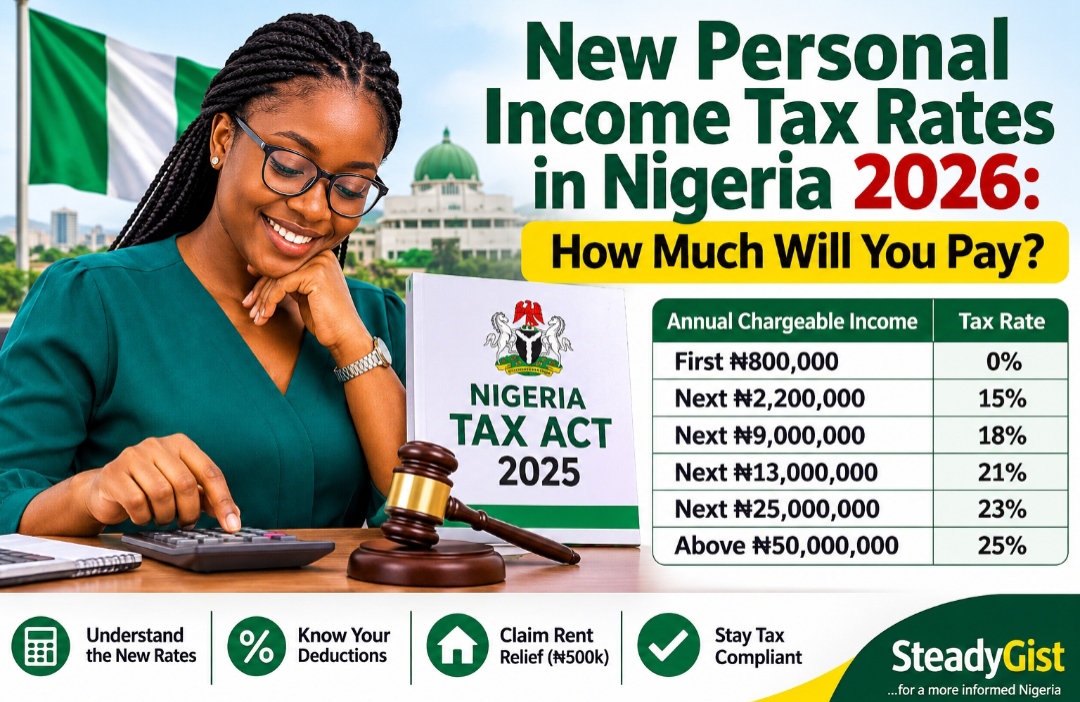
Nigeria introduced a new personal income tax structure on January 1, 2026, following the commencement of the Nigeria Tax Act 2025. The changes affect how individuals’ taxable income is calculated and how much personal income tax they are expected to pay.
One of the most significant changes is the introduction of a 0% tax band on the first ₦800,000 of annual chargeable income. The new system also introduces progressive tax rates ranging from 15% to 25%, depending on how much an individual earns after eligible deductions have been considered.
For workers, business owners, freelancers, professionals and other income earners, understanding these changes is important. It can help you estimate your tax obligations, understand deductions you may be entitled to claim and avoid confusion when reviewing your PAYE deductions or personal tax assessments.
So, how much personal income tax will you pay in Nigeria in 2026? This guide explains the new tax brackets, how the rates work, the deductions available and practical examples showing how your tax liability may be calculated.
What Are the New Personal Income Tax Rates in Nigeria for 2026?
Under the Nigeria Tax Act 2025, personal income tax is calculated using six progressive tax bands. The applicable rate increases as an individual’s annual chargeable income rises.
The rates apply to chargeable income after eligible deductions and applicable exemptions have been taken into account. They do not simply apply to an individual’s entire gross salary.
The new personal income tax rates are:
| Annual Chargeable Income | Tax Rate |
|---|---|
| First ₦800,000 | 0% |
| Next ₦2,200,000 | 15% |
| Next ₦9,000,000 | 18% |
| Next ₦13,000,000 | 21% |
| Next ₦25,000,000 | 23% |
| Above ₦50,000,000 | 25% |
These rates are provided in the Fourth Schedule of the Nigeria Tax Act 2025 and apply from January 1, 2026.
The important point is that the tax is calculated progressively. This means that an individual does not automatically pay the highest rate on their entire income simply because their earnings fall into a higher tax bracket.
Instead, each portion of chargeable income is taxed at the rate assigned to that particular band.
Who Is Exempt From Personal Income Tax in Nigeria?
The new tax framework provides relief for individuals earning lower incomes.
Under the Nigeria Tax Act 2025, the first ₦800,000 of annual chargeable income is taxed at 0%. This means an individual whose annual chargeable income does not exceed ₦800,000 will have no personal income tax liability under the progressive rate schedule.
There is also a specific exemption for individuals earning the national minimum wage in line with the National Minimum Wage Act.
However, it is important to understand the difference between gross income and chargeable income.
Gross income refers to the total income received before eligible deductions. Chargeable income is the amount remaining after the relevant deductions and exemptions have been applied.
Therefore, earning more than ₦800,000 does not automatically mean that every naira of your income will be taxed. The applicable deductions must first be considered.
How the New Personal Income Tax System Works
The 2026 personal income tax structure is progressive. Each tax band has a different rate, and the applicable percentage is charged only on the portion of chargeable income falling within that band.
For example, someone with annual chargeable income of ₦3 million does not pay 15% on the entire ₦3 million.
The first ₦800,000 is taxed at 0%, while the remaining ₦2.2 million is taxed at 15%.
This distinction is important because it prevents people from misunderstanding the new tax rates.
The following examples demonstrate how the calculation works.
Examples: How Much Tax Will You Pay Under the New 2026 Rates?
The examples below assume that the amounts shown are annual chargeable income after eligible deductions have already been applied. They are illustrations of the statutory tax bands, not estimates of everyone’s gross salary deductions.
Example 1: Someone With ₦3 Million Annual Chargeable Income
Suppose an individual has annual chargeable income of ₦3 million.
The calculation would be:
- First ₦800,000 at 0% = ₦0
- Next ₦2,200,000 at 15% = ₦330,000
Total annual personal income tax: ₦330,000.
This means the individual would pay ₦330,000 in annual personal income tax, based on the stated chargeable income.
Example 2: Someone With ₦6 Million Annual Chargeable Income
Consider another individual with annual chargeable income of ₦6 million.
The calculation is:
- First ₦800,000 at 0% = ₦0
- Next ₦2,200,000 at 15% = ₦330,000
- Remaining ₦3,000,000 at 18% = ₦540,000
Total annual personal income tax: ₦870,000.
The individual does not pay 18% on the entire ₦6 million. The 18% rate applies only to the portion that falls within that particular band.
Example 3: Someone With ₦15 Million Annual Chargeable Income
For an individual with annual chargeable income of ₦15 million, the calculation becomes:
- First ₦800,000 at 0% = ₦0
- Next ₦2,200,000 at 15% = ₦330,000
- Next ₦9,000,000 at 18% = ₦1,620,000
- Remaining ₦3,000,000 at 21% = ₦630,000
Total annual personal income tax: ₦2,580,000.
This illustrates how the progressive system works when an individual’s chargeable income crosses several tax bands.
Example 4: Someone With ₦50 Million Annual Chargeable Income
For someone with annual chargeable income of ₦50 million, the calculation is:
- First ₦800,000 at 0% = ₦0
- Next ₦2,200,000 at 15% = ₦330,000
- Next ₦9,000,000 at 18% = ₦1,620,000
- Next ₦13,000,000 at 21% = ₦2,730,000
- Next ₦25,000,000 at 23% = ₦5,750,000
Total annual personal income tax: ₦10,430,000.
Any chargeable income above ₦50 million falls into the 25% tax band. Only the amount exceeding ₦50 million is taxed at that rate.
What Deductions Can Reduce Your Personal Income Tax in Nigeria?
One important feature of the new tax system is that eligible deductions are considered before the applicable tax rates are applied.
Section 30 of the Nigeria Tax Act 2025 identifies deductions that individuals may claim when calculating their chargeable income. The Joint Revenue Board’s 2026 Personal Income Tax Guidelines also explain the requirements for claiming these deductions.
The main eligible deductions include:
1. Pension Contributions
Qualifying contributions made under the Pension Reform Act may be deducted when calculating chargeable income.
For employees, this generally includes contributions deducted from their salaries and remitted to an approved Pension Fund Administrator.
Taxpayers should retain relevant pension records as evidence of their contributions.
2. National Housing Fund Contributions
Eligible contributions made to the National Housing Fund can also be deducted.
The deduction is limited to the actual amount contributed to the fund, subject to the applicable requirements.
3. National Health Insurance Contributions
Qualifying contributions made under the National Health Insurance Scheme are recognised as eligible deductions.
The amount claimed must correspond with the actual amount deducted and remitted.
4. Interest on Loans for an Owner-Occupied Home
Individuals who obtain qualifying loans to develop, construct or purchase their principal residential property may claim the interest component as a deduction.
However, the deduction does not cover the repayment of the loan principal.
The property must be intended for the individual’s own occupation rather than being acquired for commercial or rental purposes.
5. Life Insurance Premiums
Qualifying annual premiums paid for life insurance covering the individual or their spouse may be deducted.
The deduction is limited to the amount actually paid during the relevant period.
6. Rent Relief
Rent relief is another important provision under the new tax framework.
An eligible individual may claim a deduction equal to 20% of annual rent paid, subject to a maximum of ₦500,000.
For example, if someone pays ₦1 million in annual rent, 20% of that amount is ₦200,000. The individual may therefore qualify for a ₦200,000 rent relief, provided the relevant conditions are met.
However, someone who pays ₦4 million in annual rent would calculate 20% as ₦800,000. Since the maximum allowable relief is ₦500,000, the claim would be limited to ₦500,000.
To claim rent relief, the taxpayer must accurately declare the rent paid and provide the information required by the relevant tax authority.
Important: These deductions are not automatic allowances that everyone can claim regardless of their circumstances. Eligibility, actual contributions or payments, proper declarations and supporting documents matter. The relevant tax authority may reject claims that are unsupported.
How the New Tax Rates Affect Employees in Nigeria
For employees working in the public or private sector, personal income tax is generally collected through the Pay-As-You-Earn system, commonly known as PAYE.
Under PAYE, an employer calculates the applicable tax on an employee’s taxable employment income, deducts the required amount and remits it to the relevant tax authority.
The 2026 guidelines require employers to remit PAYE deductions within ten days after the end of the month in which the deductions were made.
The new tax rates mean that employees’ tax liabilities should be calculated using the 2026 tax bands, taking eligible deductions and exemptions into account.
This is particularly important for workers who want to understand why their take-home pay may differ from their gross salary.
For example, an employee earning ₦500,000 monthly receives ₦6 million in annual gross employment income before considering eligible deductions. The employee’s chargeable income may be lower after qualifying deductions have been applied.
Consequently, the employee’s actual tax liability cannot be determined accurately from the monthly salary alone.
Workers should review their payslips and ask their employers or payroll departments for clarification where PAYE calculations appear inconsistent with the new tax framework.
How the New Tax System Affects Self-Employed Nigerians
The changes are not limited to people working for companies or government institutions.
Self-employed Nigerians, including consultants, freelancers, traders, professionals, business owners and people earning income from independent activities, may also have personal income tax obligations.
Unlike employees whose taxes are generally deducted through PAYE, self-employed individuals may be required to calculate and pay their tax through the applicable direct assessment or self-assessment procedures.
The relevant tax authority will consider their taxable income, applicable deductions and other relevant provisions when determining their liability.
For individuals operating businesses or earning income from several sources, proper financial records are particularly important.
Records of income, business transactions, qualifying expenses and eligible deductions can help support an accurate tax assessment.
People who earn money through digital services, content creation, consulting and other independent activities should not assume that their income is automatically outside the personal income tax system simply because they do not work for a traditional employer.
Does the New Tax Law Affect Freelancers and Content Creators?
Yes. The new personal income tax framework is relevant to individuals earning taxable income from independent professional and commercial activities.
This includes freelancers, digital marketers, graphic designers, web developers, influencers, content creators, consultants and other professionals.
For example, a freelance graphic designer who receives payments from multiple clients may have taxable income arising from their professional activities.
Similarly, a content creator earning money through advertising, sponsorships, brand partnerships or other commercial arrangements may have personal income tax obligations.
The relevant tax treatment depends on the nature of the income, the individual’s circumstances and applicable deductions.
The Joint Revenue Board’s 2026 guidelines specifically address income from digital and virtual assets, content creators and influencers, as well as direct assessment for individuals. This reinforces the importance of understanding how different income sources are treated under the new framework.
How Is Personal Income Tax Collected in Nigeria?
Personal income tax is administered through the relevant tax authority, depending on the taxpayer’s circumstances and applicable jurisdiction.
For most employees, PAYE is the usual collection method. Employers deduct tax from salaries and remit it to the appropriate authority.
Individuals who are self-employed or earn income outside regular employment may have to comply through direct assessment or other applicable procedures.
The 2026 Personal Income Tax Guidelines provide for individual annual income tax returns. They state that taxable individuals are expected to file returns with the relevant tax authority by March 31 of the relevant year of assessment, covering income from the preceding basis period.
The guidelines also require employers to submit annual returns covering employee emoluments by January 31.
Taxpayers should confirm the relevant filing and payment requirements with their tax authority, particularly where they have multiple income sources or operate across different jurisdictions.
What Happens If You Do Not Pay Your Personal Income Tax?
Tax compliance is an important responsibility under Nigeria’s tax framework.
Individuals who are liable to pay personal income tax are expected to register, provide accurate information, submit required returns and pay their tax obligations within the applicable deadlines.
Failure to comply may result in penalties, interest and other enforcement measures provided under the tax administration laws.
Employers also have responsibilities under the PAYE system. They are required to deduct the appropriate tax from employees’ emoluments and remit the amounts to the relevant tax authority.
For this reason, taxpayers should not ignore official tax correspondence or assume that the absence of a monthly deduction means they have no tax obligations.
Where an individual is uncertain about their tax position, seeking clarification from the relevant tax authority or a qualified tax professional is advisable.
When Did the New Personal Income Tax Rates Take Effect?
The new personal income tax rates took effect on January 1, 2026, under the Nigeria Tax Act 2025.
The Federal Government’s transition guidelines explain how tax obligations relating to periods before and after that date are treated.
Generally, tax liabilities and related matters concerning periods before January 1, 2026, remain subject to the applicable previous tax laws. Income and tax obligations falling under the new framework from the commencement date are administered under the 2025 tax legislation.
This distinction matters because the new rates should not automatically be applied retrospectively to income from earlier tax periods.
Frequently Asked Questions About Personal Income Tax in Nigeria 2026
1. What is the personal income tax rate in Nigeria in 2026?
Nigeria’s personal income tax rates in 2026 range from 0% to 25%. The first ₦800,000 of annual chargeable income is taxed at 0%, while higher portions are taxed progressively at 15%, 18%, 21%, 23% and 25%.
2. Is the first ₦800,000 income tax-free in Nigeria?
Yes. The first ₦800,000 of annual chargeable income falls within the 0% tax band under the Nigeria Tax Act 2025.
3. Do Nigerians earning ₦70,000 minimum wage pay personal income tax?
Individuals earning the national minimum wage in line with the National Minimum Wage Act are exempt under the relevant provisions of the new tax framework. The exemption should be understood in relation to the statutory minimum wage, rather than treating every person earning ₦70,000 from any source as automatically exempt.
4. How much tax will I pay if my annual chargeable income is ₦3 million?
Based on the 2026 tax bands, an individual with ₦3 million in annual chargeable income would pay ₦330,000 in personal income tax.
5. Is rent deductible from personal income tax in Nigeria?
Yes. Eligible individuals can claim rent relief equal to 20% of annual rent paid, subject to a maximum deduction of ₦500,000 and the applicable declaration and documentation requirements.
6. Do freelancers pay personal income tax in Nigeria?
Freelancers may be liable to personal income tax on their taxable income. Their obligations depend on their income, applicable deductions and relevant tax rules.
7. Are the new personal income tax rates applicable to everyone in Nigeria?
The rates apply to individuals whose income is chargeable under the Nigeria Tax Act 2025, subject to the exemptions and special provisions in the law. Specific circumstances, including minimum-wage exemptions and the nature of income, may affect the final tax liability.
8. Does everyone earning above ₦800,000 pay 15% tax on their entire income?
No. Nigeria uses a progressive tax system. The 15% rate applies only to the portion of chargeable income falling within the second tax band. Higher rates apply only to the portions falling within their respective bands.
9. Can I calculate my personal income tax without knowing my deductions?
You can estimate your tax using your chargeable income, but an accurate calculation requires you to account for eligible deductions and exemptions. Your gross salary alone may not be sufficient.
10. When did Nigeria’s new personal income tax rates become effective?
The new rates became effective on January 1, 2026, under the Nigeria Tax Act 2025.
Conclusion: Understand Your Tax Obligations Under Nigeria’s 2026 Tax Law
Nigeria’s new personal income tax structure introduces a progressive system that begins with a 0% rate on the first ₦800,000 of annual chargeable income and rises to 25% for the portion exceeding ₦50 million.
The changes make it important for employees, freelancers, professionals, business owners and other income earners to understand how their taxable income is determined.
However, the actual amount an individual pays depends on more than their gross earnings. Eligible deductions, exemptions, the source of income and the applicable tax administration procedures all play a role.
Understanding the new rates can help taxpayers review their PAYE deductions, claim legitimate reliefs and prepare for their tax responsibilities.
For more explanations of Nigeria’s tax reforms, economic policies and developments affecting individuals and businesses, keep following SteadyGist.com.
Disclaimer: This article is for general information and educational purposes. It is not a substitute for professional tax or legal advice. Individual tax liabilities depend on personal circumstances and the applicable provisions of Nigerian tax law.


Efya Marries Nigerian Musician Tomi Thomas Years After Saying She Would Never Marry

Nigerian Newspapers: Top 10 Nigerian News Headlines Today Tuesday

Tinubu to Visit Jigawa for APC Rally as Government Declares Tuesday Public Holiday
-
Gov. Ambode11 years ago
Lagos commences prosecution of 28 tax defaulters
-
Politics9 years ago
Presidency reacts to Wole Soyinka’s comments about Buhari Being in a ‘Trance’
-
Donald Trump6 years ago
Twitter, Facebook block Trump over Capitol attack posts
-
Fashion9 years ago
These ’90s fashion trends are making a comeback in 2017
-
Entertainment9 years ago
The final 6 ‘Game of Thrones’ episodes might feel like a full season
-

 Entertainment3 years ago
Portable boasts of owning 30 Mansion Across Lagos and Ogun State
-
Fashion9 years ago
According to Dior Couture, this taboo fashion accessory is back
-
 Mohbad2 years ago
DNA Test Demanded for Mohbad’s Son Before Singer’s Burial